

What Are Polycarbonate Roof Screws?
Polycarbonate roof screws are fastening components designed to secure polycarbonate roofing sheets to timber, steel, aluminum, or other roof support structures. Although they may look similar to standard roofing screws, the complete fixing system is especially important when working with polycarbonate because the material expands and contracts as temperatures change.
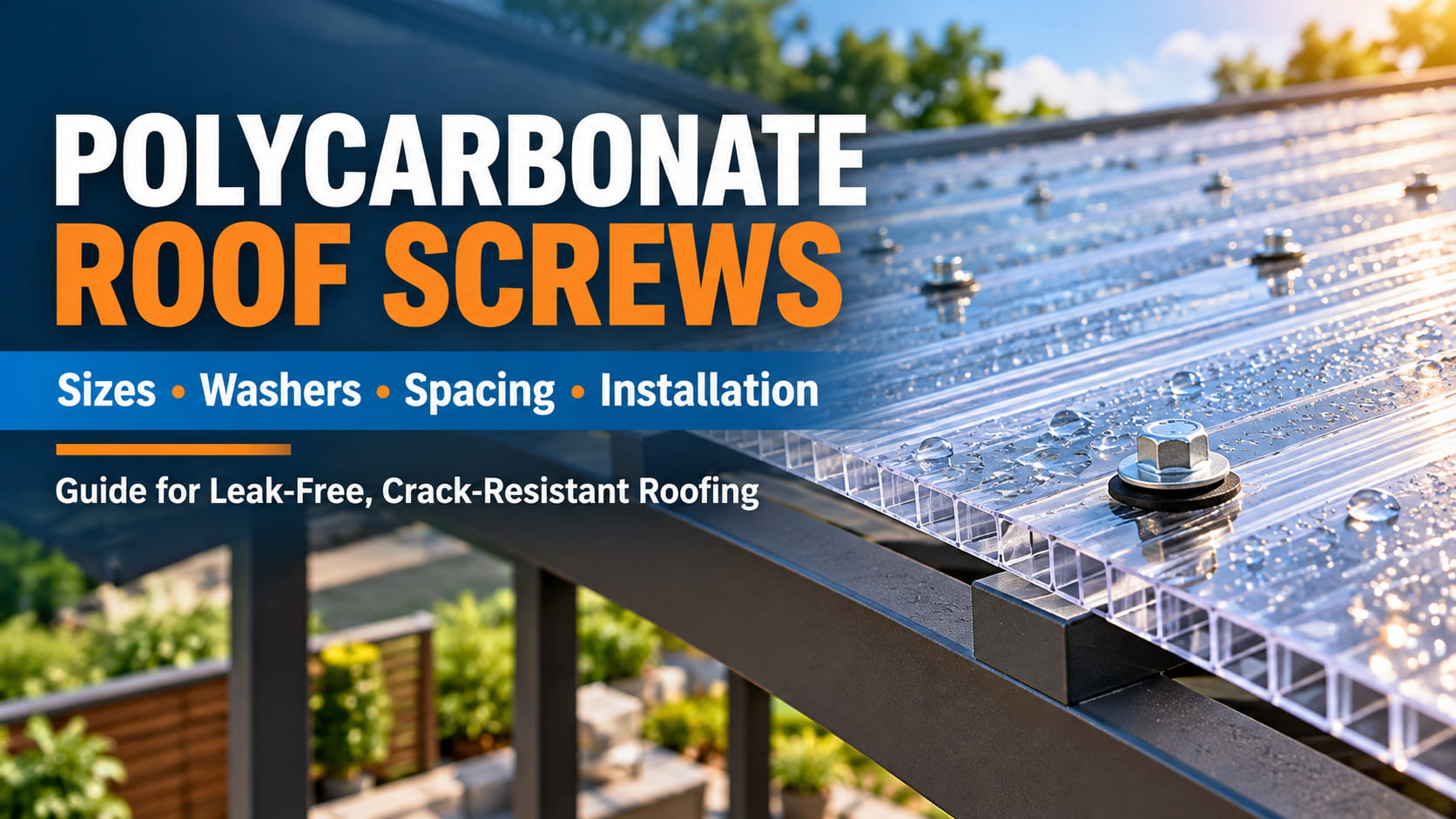
A typical polycarbonate roof fixing may include a self-drilling or self-tapping screw, a weather-resistant metal washer, an EPDM or rubber sealing washer, and in some systems a larger fixing button, spacer, or cap. These components work together to secure the sheet while helping prevent rainwater from entering around the screw hole.
The main difference between ordinary screws and suitable polycarbonate roof screws is not simply the screw thread. The fixing method must account for sheet movement, waterproofing, loading, profile shape, substrate material, and the risk of local stress around drilled holes.
Where Are Polycarbonate Roof Screws Commonly Used?
Polycarbonate roofing is widely used because it is lightweight, impact resistant, translucent, and relatively easy to install. Suitable screws may therefore be found in many residential, commercial, agricultural, and light-industrial applications.
- Patio and pergola roofing
- Greenhouse roofing and wall panels
- Carports and covered walkways
- Garden sheds and workshops
- Canopies and awnings
- Outdoor storage areas
- Farm buildings and livestock shelters
- Industrial daylight roofing sections
The correct fixing method depends on whether the roofing is corrugated, multiwall, solid, or another profiled polycarbonate sheet. Manufacturer installation requirements should therefore always be checked before drilling or fastening.
Why Do Polycarbonate Roofing Sheets Need the Correct Screws?
A polycarbonate roof is continuously exposed to sunlight, wind, rain, temperature variation, vibration, and structural movement. The fixing points must therefore hold the sheet securely without creating excessive stress. Using unsuitable screws or installing the correct screws incorrectly can shorten the service life of the roof.
Thermal Expansion Is a Major Installation Factor
Polycarbonate expands when heated and contracts when temperatures fall. This movement can be significant across long roofing sheets. If a screw hole is too tight around the fastener, the sheet may not be able to move naturally. Stress can then develop around the fixing point, increasing the possibility of cracking, buckling, distortion, or elongated holes.
For this reason, many polycarbonate roofing systems require holes to be drilled slightly larger than the screw shaft. The exact allowance varies according to the sheet type, roof length, climate, and manufacturer instructions.
Weather Sealing Matters
Every screw creates a penetration through the roofing sheet. Without an appropriate sealing washer, water can move through the fixing hole during rain. A correctly installed EPDM or comparable roofing washer compresses around the penetration and forms a seal.
The washer should be compressed enough to seal but not crushed excessively. Too little compression may leave a leak path, while too much tightening may deform the washer and place unnecessary pressure on the polycarbonate sheet.
Wind and Structural Loads Must Be Transferred Safely
Roof sheets can experience uplift forces during strong winds. The screw pattern and fixing spacing help distribute these forces into the supporting frame. Too few fixings may allow movement or lifting, while excessive fixing density can unnecessarily restrict sheet movement and create more penetration points.
The appropriate spacing depends on roof design, wind exposure, sheet profile, support spacing, building height, geographic location, and product specifications. A universal screw spacing should therefore not be applied to every roof.
How to Install Polycarbonate Roof Screws in 5 Steps
Correct installation starts before the first screw is driven. The support structure, roofing profile, drilling method, washer condition, screw length, and sheet movement requirements should all be checked in advance.
Step 1: Confirm the Roofing Sheet and Support Material
First identify whether the roof sheets are corrugated polycarbonate, multiwall sheets, solid sheets, or another system. Then determine whether the supporting structure is timber, light-gauge steel, structural steel, or aluminum.
A screw designed for timber does not use the same thread form as one intended for steel. Likewise, the required screw length changes according to the roofing profile, washer thickness, spacer height, and depth needed to engage the supporting member securely.
Step 2: Select the Correct Screw Length and Washer
The screw must be long enough to pass through the roofing assembly and achieve adequate engagement with the support. It should also be compatible with the environmental conditions. Exterior roofing commonly requires corrosion-resistant coatings, stainless steel, or another material appropriate for the location.
Washer diameter is equally important. A washer that is too small may concentrate pressure around the hole, while a properly sized roofing washer spreads load across a wider area and supports a more reliable seal.
Step 3: Mark the Fixing Points and Pre-Drill Where Required
Follow the sheet manufacturer's recommended fixing locations. Depending on the roofing profile, screws may be installed through designated crowns, valleys, fastening points, glazing bars, or proprietary fixing systems.
Where pre-drilling is required, the hole should generally provide sufficient clearance for expansion without becoming so large that the washer cannot seal properly. Use a sharp drill bit and avoid forcing the bit through the sheet. A clean hole helps reduce local cracking and stress.
Step 4: Drive the Screw Squarely Without Over-Tightening
Keep the screw perpendicular to the sheet and support surface. Angled screws can distort the washer and create uneven sealing pressure. Drive the screw until the sealing washer sits firmly against the roofing sheet, but stop before the washer is excessively flattened or the polycarbonate begins to dish around the fixing.
Important: The goal is to secure and seal the sheet, not clamp it rigidly. Excessive tightening is one of the most common causes of stress around polycarbonate roof screw holes.
Step 5: Inspect Every Fixing After Installation
After completing the roof, inspect each fixing from above where safe to do so. Look for tilted screws, distorted washers, cracked sheet edges, compressed roofing profiles, missed supports, loose screws, or washers that have not sealed correctly.
A final inspection is much easier than diagnosing a leak after the first heavy rain. It also provides an opportunity to verify that overlapping sheets, closures, flashing, ridge details, and edge trims are correctly positioned.
Polycarbonate Roof Screw Selection Checklist
| Item to Check | What to Consider | Why It Matters |
|---|---|---|
| Roof sheet type | Corrugated, solid, multiwall, profiled or proprietary system | Different sheets require different fixing positions and accessories |
| Support material | Timber, steel, aluminum or other framing | Determines screw thread and drilling requirements |
| Screw length | Roof profile height, washer, spacer and support engagement | Ensures the fixing properly engages the structural support |
| Washer material | EPDM or roofing-grade sealing washer | Helps seal the fixing point against rainwater |
| Corrosion resistance | Climate, coastal exposure, humidity and chemical environment | Reduces premature screw corrosion and staining |
| Hole clearance | Manufacturer's thermal expansion requirements | Allows the sheet to expand and contract without excessive stress |
| Fixing spacing | Wind load, sheet profile, purlin spacing and roof location | Helps distribute structural loads safely |
| Installation pressure | Washer should seal without being crushed | Prevents leaks, distortion and stress cracking |
Common Polycarbonate Roof Screw Installation Mistakes to Avoid
Many roofing problems do not result from defective polycarbonate sheets. Instead, they begin at the fixing points. Avoiding a few common mistakes can improve roof appearance, sealing performance, and long-term reliability.
1. Over-Tightening the Screws
A screw driven too tightly can crush the sealing washer, distort the roofing profile, and create a depression around the fixing point. It may also restrict thermal movement and increase stress around the hole.
2. Using a Hole That Is Too Tight
When the hole closely grips the screw shaft, the roofing sheet has less room to move as temperatures change. Over time, this can encourage cracking or distortion. Follow the specified oversize-hole requirement for the particular roofing product.
3. Using Ordinary Washers
A standard metal washer without an appropriate sealing component may not provide a weather-tight fixing. Roofing washers are designed to combine load distribution and sealing. The washer material should also be suitable for long-term UV and outdoor exposure.
4. Choosing the Wrong Screw Length
A screw that is too short may not properly engage the support. A screw that is unnecessarily long can make installation more difficult and may interfere with underlying materials. Measure the complete roofing assembly before selecting the fixing.
5. Guessing the Screw Spacing
Fixing every second or third corrugation without checking the product specification may produce insufficient restraint in one project and unnecessary fixing density in another. Roof edge zones and corners may also require different fixing arrangements because wind pressures can be higher.
6. Driving Screws at an Angle
Angled screws prevent the washer from sitting evenly against the sheet. This can create one-sided compression, a poor seal, and visible distortion. Keep the drill or driver aligned with the fixing point whenever possible.
7. Ignoring the Manufacturer's Roofing System
Polycarbonate roofing is often designed as a complete system involving sheets, flashing, closures, profiles, glazing bars, tapes, caps, fasteners, and sealants. Replacing one component with an unsuitable alternative can affect the entire roof assembly.
Best Practices for Better Polycarbonate Roof Performance
Match the Fastener to the Substrate
Timber, thin steel, and heavier structural steel require different screw designs. Selecting a screw by length alone is not enough. Thread pattern, point type, drilling capacity, head style, coating, washer diameter, and support penetration all influence installation quality.
Plan for Expansion Before Installing the First Sheet
Thermal movement should be considered when setting sheet lengths, overlaps, edge clearances, fixing holes, and joining profiles. Trying to solve expansion problems after the roof has already been fixed is much more difficult.
Use Controlled Driver Settings
A powered impact driver can install screws quickly, but excessive speed or torque makes it easy to over-tighten fixings. A controlled drill-driver setting or experienced torque control can help produce more consistent washer compression.
Inspect the Roof Periodically
Outdoor fixings remain exposed to UV radiation, moisture, temperature cycling, dust, debris, and movement. Periodic visual inspection can identify damaged washers, corrosion, loosened fasteners, cracked sheets, or movement around fixing points before they become larger problems.
Consider the Entire Roof, Not Only the Screws
Even the best polycarbonate roof screws cannot compensate for incorrect roof pitch, insufficient support, poorly positioned overlaps, incompatible sealants, blocked drainage, or incorrectly installed flashing. Long-term roof performance depends on the complete assembly working together.
Conclusion: Choose Polycarbonate Roof Screws as Part of the Complete Roofing System
Polycarbonate roof screws may be small components, but they have a major effect on roofing performance. The correct fastener must secure the sheet, maintain an effective weather seal, resist corrosion, engage the supporting structure, and still allow the polycarbonate to respond to temperature changes.
Before purchasing screws, confirm the roofing sheet type, support material, required screw length, sealing washer, fixing spacing, drilling requirements, and environmental conditions. During installation, avoid over-tightening and make sure every washer sits evenly against the roof sheet.
Most importantly, do not treat polycarbonate roof screws as isolated hardware. They are one part of a complete roofing system. Following the roof sheet manufacturer's fixing instructions remains the most reliable way to determine the correct hole size, spacing, support arrangement, accessories, and installation method for a specific project.
Next Step:
Before ordering polycarbonate roof screws, prepare the roof sheet specification, sheet thickness or profile, support material, roof dimensions, exposure conditions, and installation requirements. This information makes it easier to compare suitable fasteners and avoid selecting screws based only on diameter or price.
Polycarbonate Roof Screws FAQ
Q1: What screws should I use for polycarbonate roofing?
Use roofing screws compatible with the support material and the specific polycarbonate roofing system. They should normally include a suitable weather-sealing washer and provide enough length to secure the sheet assembly into the timber or metal support.
Q2: Do polycarbonate roof screws need rubber washers?
Polycarbonate roof fixings commonly use EPDM or another roofing-grade sealing washer. The washer helps seal the screw penetration against water while spreading pressure around the fixing point. Always confirm the washer type recommended by the roofing manufacturer.
Q3: Should I pre-drill holes for polycarbonate roof screws?
Many polycarbonate roofing systems require pre-drilled holes that are slightly larger than the screw shaft so the sheet can expand and contract. The correct hole size depends on the roofing product, sheet length, and manufacturer's installation instructions.
Q4: How tight should polycarbonate roof screws be?
The screw should be tight enough for the sealing washer to sit firmly and create a weather seal, but it should not be driven so tightly that the washer is crushed or the roofing sheet visibly deforms around the fixing point.
Q5: Why do polycarbonate sheets crack around screws?
Cracking can result from over-tightening, inadequate hole clearance, poor drilling technique, incorrect fixing positions, unsupported sheet movement, impact damage, or thermal expansion being restricted around the screw hole.
Q6: Can I use normal metal roofing screws on polycarbonate sheets?
Not automatically. The screw, washer, length, drilling method, and fixing system all need to be compatible with the polycarbonate roofing product. Standard roofing screws may be suitable in some systems, but only when they meet the manufacturer's requirements.
Q7: How far apart should polycarbonate roof screws be?
There is no single spacing suitable for every roof. Fixing spacing depends on the sheet profile, roof support spacing, wind load, roof edge zones, building location, and manufacturer's specifications. Always use the spacing given for the particular roofing system.
Q8: Can polycarbonate roof screws cause leaks?
Yes. Leaks may occur if the washer is damaged, incorrectly compressed, installed at an angle, missing, deteriorated, or unable to cover the fixing hole correctly. Incorrect screw positioning can also contribute to water entry.
Q9: Are stainless steel screws suitable for polycarbonate roofing?
Stainless steel may be suitable where corrosion resistance is important, but compatibility with the roofing system, support material, washer, and environmental conditions should still be checked. Material choice should not be based on corrosion resistance alone.
Q10: How do I choose the correct length for polycarbonate roof screws?
Calculate the total thickness of the roofing profile, washer or spacer, and any intermediate components, then allow enough screw length to achieve secure engagement with the support. The required penetration depends on whether the frame is timber, steel, or another material.