

Before Starting a Collagen Supplement ODM Project: Do These 3 Things First
A collagen supplement ODM project can look simple at the beginning: choose collagen, add flavor, select packaging, and launch the product. In practice, product development often becomes more complicated once ingredient specifications, dosage targets, taste, solubility, packaging, minimum order quantities, testing requirements, lead times, and market regulations are considered together. Brands that start without a clear product brief may spend weeks revising formulas without reaching a commercially viable product.
The most effective way to manage a collagen supplement ODM project is to define the commercial objective before discussing technical details. A formula that looks impressive on paper may not work if it tastes unpleasant, exceeds the target cost, requires an unrealistic serving size, or cannot be packed in the desired format. The ODM process should therefore connect product positioning, formulation feasibility, manufacturing capability, quality control, and market requirements from the beginning.
Do these 3 things first:
- Define the target consumer: Decide whether the product is aimed at beauty consumers, active adults, mature consumers, premium wellness buyers, or another specific segment
- Define the finished product format: Decide whether you prefer powder sachets, jars, tablets, capsules, liquids, gummies, or another dosage form
- Set commercial limits: Establish your target unit cost, order quantity, packaging concept, launch market, and desired launch date before formulation begins
These three decisions help the collagen supplement ODM manufacturer determine what is technically realistic. They also reduce unnecessary sampling cycles because the development team can evaluate ingredients, processing methods, packaging, and quality requirements against a clear commercial target rather than developing a formula without constraints.
Common Collagen Supplement ODM Problems and How to Identify Them
When a collagen supplement ODM project becomes delayed, the cause is often not one single manufacturing problem. Formula design, raw material characteristics, sensory performance, packaging, production requirements, and commercial expectations are interconnected. Identifying the actual bottleneck before requesting another formulation revision can save significant development time.
| Problem | How to Identify It | Recommended Action |
|---|---|---|
| Poor taste or odor | Prototype has a strong marine, protein, or raw-material aftertaste | Review collagen source, flavor system, sweetener balance, acidity, and supporting ingredients |
| Poor solubility | Powder floats, clumps, settles, or takes too long to disperse | Review particle characteristics, serving size, mixing instructions, and formulation compatibility |
| Serving size is too large | The desired collagen amount and supporting ingredients cannot fit the intended dosage form | Prioritize ingredients or change the product format |
| Target cost is too low | Formula, packaging, and testing requirements exceed the commercial budget | Adjust raw materials, packaging, formula complexity, or order volume |
| Packaging mismatch | The selected packaging does not fit powder volume, stability needs, or manufacturing equipment | Confirm packaging feasibility before final formula approval |
| Long development cycle | Brand repeatedly changes flavor, ingredients, claims, dosage, or packaging | Freeze the product brief and use formal sample-approval checkpoints |
| Compliance uncertainty | Label claims or ingredients have not been reviewed for the intended market | Conduct regulatory review before artwork and mass production |
7-Step Collagen Supplement ODM Troubleshooting Process
If your collagen supplement ODM project is already in development but progress has slowed, use a structured review instead of requesting broad changes such as “make it taste better” or “make it more premium.” A clear troubleshooting process allows both the brand and manufacturer to identify which variable should be changed first.
Step 1: Reconfirm the Product Positioning
Start by restating who the product is for, why the consumer would choose it, and where it will be sold. A mass-market flavored collagen powder has very different requirements from a premium beauty supplement, sports-oriented collagen formula, or minimalist unflavored product. Product positioning influences ingredient selection, packaging, flavor intensity, serving size, cost, and even the style of marketing communication.
Step 2: Confirm the Collagen Source and Specification
Collagen materials are not interchangeable simply because they are all marketed as collagen. Different raw materials may vary in source, sensory characteristics, peptide profile, documentation, particle behavior, cost, and supply availability. Ask the ODM supplier for clear specifications and supporting documentation for the exact material proposed for your formula rather than evaluating only the ingredient name.
For brands comparing marine and bovine collagen, the choice should not be based on marketing language alone. Consider target consumers, allergen considerations, dietary positioning, flavor profile, cost, sourcing expectations, documentation, and the regulations of the intended sales market.
Step 3: Review the Entire Formula, Not Just the Collagen
Many collagen supplement ODM products combine collagen with vitamins, minerals, botanical ingredients, hyaluronic acid, flavor systems, acids, sweeteners, or other functional ingredients. Every additional component can influence flavor, powder flow, solubility, stability, serving size, manufacturing complexity, cost, and labeling.
If the formula has become too complicated, divide the ingredient list into three groups: essential ingredients, supporting ingredients, and optional marketing ingredients. This prioritization makes it easier to reduce cost or improve sensory performance without losing the core product concept.
Step 4: Test Taste, Aroma, Texture, and Solubility Together
A prototype should not be approved only because the ingredient list looks attractive. Prepare it exactly as the consumer is expected to use it and evaluate aroma when the package is opened, mixing behavior, foam, sediment, mouthfeel, sweetness, acidity, aftertaste, and overall convenience.
For powder products, evaluate the prototype in the intended amount of water and at the intended temperature. A powder that performs well under laboratory mixing may behave differently when stirred by hand in a glass or shaken in a bottle. Consumer-use conditions should therefore be part of product validation.
Step 5: Check Whether the Packaging Matches the Formula
Packaging should be considered before final formula approval. A large serving of collagen powder may require a larger sachet than originally planned. Hygroscopic ingredients may require stronger moisture protection. A jar product may require a scoop, suitable headspace, and appropriate closure. Liquid formats may have completely different stability and processing requirements.
Ask the collagen supplement ODM supplier to confirm fill weight, package dimensions, available production equipment, packaging material options, carton configuration, and any special storage requirements before artwork is finalized.
Step 6: Review Testing and Quality-Control Requirements
A professional ODM project should include a defined quality-control plan. The exact tests depend on the product format, ingredients, manufacturing process, intended shelf life, and sales market. Brands should ask what incoming raw-material checks, in-process controls, finished-product testing, microbiological testing, stability evaluation, and documentation are available or required for the specific product.
Do not assume that every certificate covers every risk. Clarify whether documents relate to the manufacturer, the raw material, the specific production batch, or a third-party quality program. Request documentation relevant to the actual product you intend to sell.
Step 7: Freeze the Final Specification Before Mass Production
One of the most common reasons for ODM delays is continued modification after the project is technically ready. Before placing a mass-production order, confirm the final formula, ingredient specifications, flavor, serving size, package size, artwork version, quantity, testing plan, shipping configuration, production lead time, and approval responsibilities.
A formal specification sheet and signed sample approval can reduce misunderstandings. If anything changes after approval, document the change clearly rather than relying on informal messages.
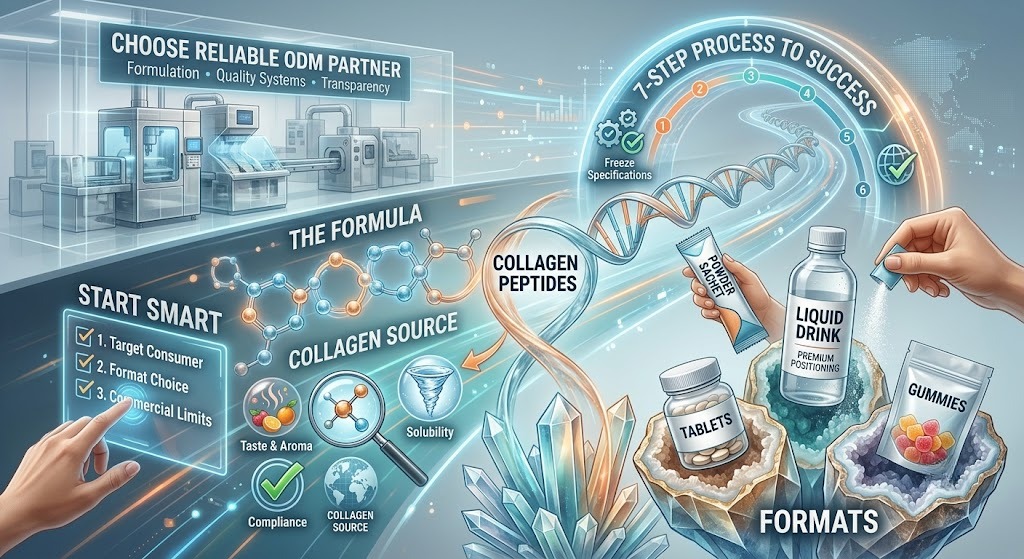
Choosing the Right Collagen Supplement Format for Your ODM Project
The finished dosage form has a major impact on formulation flexibility, consumer experience, packaging cost, manufacturing complexity, and minimum order quantity. Brands should choose the format based on both marketing strategy and technical feasibility.
| Format | Advantages | Points to Check |
|---|---|---|
| Powder Sachets | Portable, pre-portioned, suitable for larger serving sizes | Taste, solubility, sachet size, moisture protection, fill weight |
| Powder Jar | Flexible serving size and potentially efficient packaging for larger quantities | Scoop size, sealing, headspace, consumer dosing consistency |
| Capsules | Convenient and avoids flavor challenges | Limited fill capacity may require many capsules for higher ingredient quantities |
| Tablets | Familiar format with controlled unit dosing | Tablet size, compression characteristics, swallowability |
| Liquid | Ready-to-consume experience and strong premium positioning potential | Stability, preservation strategy, flavor, packaging weight, shipping cost |
| Gummies | Consumer-friendly and differentiated format | Ingredient-loading limitations, texture, stability, sugar or sweetener system |
What to Check Before Approving a Collagen Supplement ODM Manufacturer
Choosing a collagen supplement ODM manufacturer should involve more than comparing quotations. A low unit price does not automatically mean a lower total project cost if product development is slow, documentation is incomplete, packaging is frequently delayed, or the finished formula does not meet your target consumer experience.
- Formulation capability: Can the technical team develop and revise the formula rather than only manufacture a fixed recipe?
- Collagen sourcing: Can the supplier explain source, specifications, documentation, and alternative material options?
- Manufacturing capability: Does the facility support the dosage form and packaging format you need?
- Quality systems: Can the manufacturer explain its raw-material controls, production controls, testing, traceability, and documentation process?
- Sample process: Is there a clear system for prototype development, revision, and final approval?
- Packaging coordination: Can the ODM team manage sachets, jars, bottles, labels, cartons, or other packaging components?
- Regulatory communication: Can the supplier provide product documentation needed for your own market review?
- MOQ transparency: Are minimum order quantities clearly explained for formula, packaging, flavor, and printing?
- Lead-time transparency: Are development, material purchasing, printing, manufacturing, testing, and shipment stages separated clearly?
A reliable collagen supplement ODM partner should also be willing to explain limitations. If your requested formula cannot fit into the desired capsule count, your target cost is unrealistic, or the packaging requires a larger production volume, it is better to identify the issue before production rather than after a purchase order has been placed.
When Should You Ask for Professional Technical Support?
Some ODM issues can be solved by clarifying the brief, but others require technical, quality, packaging, or regulatory expertise. If any of the following situations occur, avoid approving mass production until the issue has been reviewed.
- The prototype repeatedly separates, clumps, changes texture, or develops unexpected odor
- The final ingredient amounts are unclear or different documents show different specifications
- The desired packaging cannot reliably contain the required serving size
- You are unsure whether a proposed marketing claim is appropriate for the target market
- Raw-material documentation is incomplete or does not match the ingredient being offered
- A supplier cannot clearly explain testing, traceability, or batch-release procedures
- The product is intended for multiple countries with different regulatory requirements
- Any material, formula, packaging, or process changes after the final sample has already been approved
Regulatory requirements differ by country, product category, ingredient, claim, and distribution model. A collagen supplement ODM manufacturer can provide technical documents and manufacturing support, but the brand owner should independently confirm that the finished product, label, advertising, and claims are suitable for the intended market before commercial launch.
Practical Tips to Reduce Collagen Supplement ODM Development Delays
Fast development does not mean skipping important checks. It means making decisions in the right order. Most unnecessary delays happen when formula, flavor, packaging, cost, and marketing requirements are changed independently rather than managed as one project.
- Create a one-page product brief: Include target consumer, product concept, dosage form, key ingredients, target price, packaging, sales market, MOQ, and launch date
- Separate must-have features from optional features: This makes cost and formulation adjustments easier
- Compare prototypes systematically: Score flavor, aroma, sweetness, acidity, mouthfeel, solubility, appearance, and overall preference
- Do not finalize artwork too early: Wait until formula, serving size, package dimensions, and required label content are sufficiently confirmed
- Ask for a written project timeline: Separate sample development, approvals, raw-material ordering, packaging printing, production, testing, and shipment
- Keep one decision owner: Multiple internal reviewers can provide feedback, but one person should consolidate changes before sending them to the ODM manufacturer
- Approve specifications, not assumptions: Confirm exact ingredients, amounts, packaging, quantity, and quality requirements in writing before mass production
A successful collagen supplement ODM project is not simply about finding a factory that can make collagen products. It is about finding a manufacturing partner that can translate a commercial idea into a product specification that is manufacturable, consistent, acceptable to consumers, appropriately documented, and suitable for the intended market.
If your project is still at the concept stage, begin with the target consumer, dosage form, price range, and sales market. If development is already underway but has stalled, review the seven troubleshooting steps above and identify the exact bottleneck before requesting the next sample. Clear specifications and structured approvals usually provide a faster path to commercialization than repeatedly changing the formula without a defined decision framework.
Collagen Supplement ODM FAQ
Q1: What does collagen supplement ODM mean?
Collagen supplement ODM generally refers to a manufacturing service in which a supplier supports product development and manufacturing based on a brand's requirements. Services may include formulation, ingredient sourcing, sampling, manufacturing, packaging coordination, testing, and product documentation depending on the supplier.
Q2: What information should I prepare before contacting a collagen supplement ODM manufacturer?
Prepare your target consumer, product concept, preferred dosage form, desired ingredients, target serving size, target cost, expected order quantity, packaging concept, sales market, and desired launch date. A clearer brief usually leads to a more efficient quotation and sampling process.
Q3: Can a collagen supplement ODM manufacturer create a custom formula?
Many ODM suppliers can develop customized formulas, but capabilities vary. Ask whether the supplier offers original formulation, modification of existing bases, flavor development, technical feasibility review, and prototype revision before placing an order.
Q4: How should I choose between marine and bovine collagen?
Evaluate the target consumer, product positioning, sensory profile, sourcing preferences, allergen considerations, ingredient documentation, cost, supply stability, and the requirements of the intended sales market rather than choosing based only on marketing terminology.
Q5: Why does a collagen powder sometimes taste unpleasant?
Taste can be influenced by the collagen raw material, supporting ingredients, vitamins, minerals, acids, botanical extracts, sweeteners, flavors, and serving concentration. Improving sensory quality may require adjusting the entire formulation rather than simply adding more flavor.
Q6: Why does collagen powder clump or dissolve slowly?
Clumping or slow dispersion may be related to particle characteristics, moisture exposure, serving size, other ingredients in the formula, mixing conditions, or packaging. The ODM manufacturer should evaluate the finished formulation under realistic consumer-use conditions.
Q7: What determines the MOQ for collagen supplement ODM?
MOQ can be affected by manufacturing equipment, batch size, formula complexity, raw-material purchasing requirements, packaging type, printed packaging minimums, flavor customization, and testing requirements. Ask for separate MOQ information for both the product and packaging components.
Q8: What affects the cost of a collagen supplement ODM project?
Cost may be affected by collagen source and specification, ingredient amounts, additional functional ingredients, flavor system, dosage form, packaging, order quantity, testing, documentation, printing requirements, and logistics. Request a quotation based on a defined specification rather than comparing unit prices alone.
Q9: What should I approve before collagen supplement mass production?
Confirm the final formula, ingredient specifications, flavor, serving size, finished product format, package dimensions, artwork version, quantity, quality-control plan, testing requirements, production lead time, and shipping configuration before mass production begins.
Q10: How can I choose a reliable collagen supplement ODM partner?
Evaluate formulation capability, collagen sourcing, manufacturing equipment, quality systems, testing, documentation, sample development, packaging coordination, communication, MOQ transparency, lead times, and the supplier's ability to explain technical limitations before choosing a manufacturing partner.